
Why Pokemon FireRed and LeafGreen are still great 20 years later
FireRed & LeafGreen on Switch: The Kanto I Didn’t Think I Wanted Again
I went into the Switch versions of Pokémon FireRed and LeafGreen half-expecting to bounce off them. I’m tired of Kanto. I’ve played Red/Blue, I’ve played the Let’s Go remakes, I’ve watched the anime arcs more times than I’d admit. When these GBA remakes were announced for Switch, my first reaction was basically: “More Kanto? Really?”
Then I sank a little over 35 hours into FireRed on Switch, rolled credits, started poking at the Sevii Islands, and realized something I genuinely wasn’t prepared for: as outdated as some bits are, this is still the best way to experience Kanto. Not the flashiest. Not the most convenient. But the one that actually feels like playing Pokémon instead of gliding through it on autopilot.
At the same time, living with these games in 2026 is messy. Kanto’s design quirks are still here. Generation 3’s strangled movepools can be painful. The Switch ports stubbornly avoid basic modern conveniences, and the way non-Kanto Pokémon are locked away until the postgame feels contrived. I kept thinking, “This rules” and “Why is this still like this?” in the same hour.
Key Takeaways
- Still the definitive Kanto: Cleaner GBA-era visuals, tighter pacing, and Sevii Islands postgame make this the most complete classic Kanto package.
- Harder than modern games (in a good way): No party-wide Exp Share, real dungeons, and resource management make battles and caves feel meaningful again.
- Old-school limits: The main story locks you to Kanto Pokémon, with most Johto/Hoenn options and evolutions gated behind postgame or not available at all.
- Some very dated design: Awkward region layout, bad movepools, no running indoors, and no online trading hold it back on Switch.
- Great value at $20: Around 35-40 hours for a single playthrough, plus postgame and built-in event legendaries, if you’re willing to live with the old-school friction.
Kanto, Cleaned Up Instead of Rebuilt
Coming from the original Game Boy games (or even Let’s Go), FireRed and LeafGreen feel like someone took Kanto, swept up all the loose screws, and put it back together without adding any flashy new furniture.
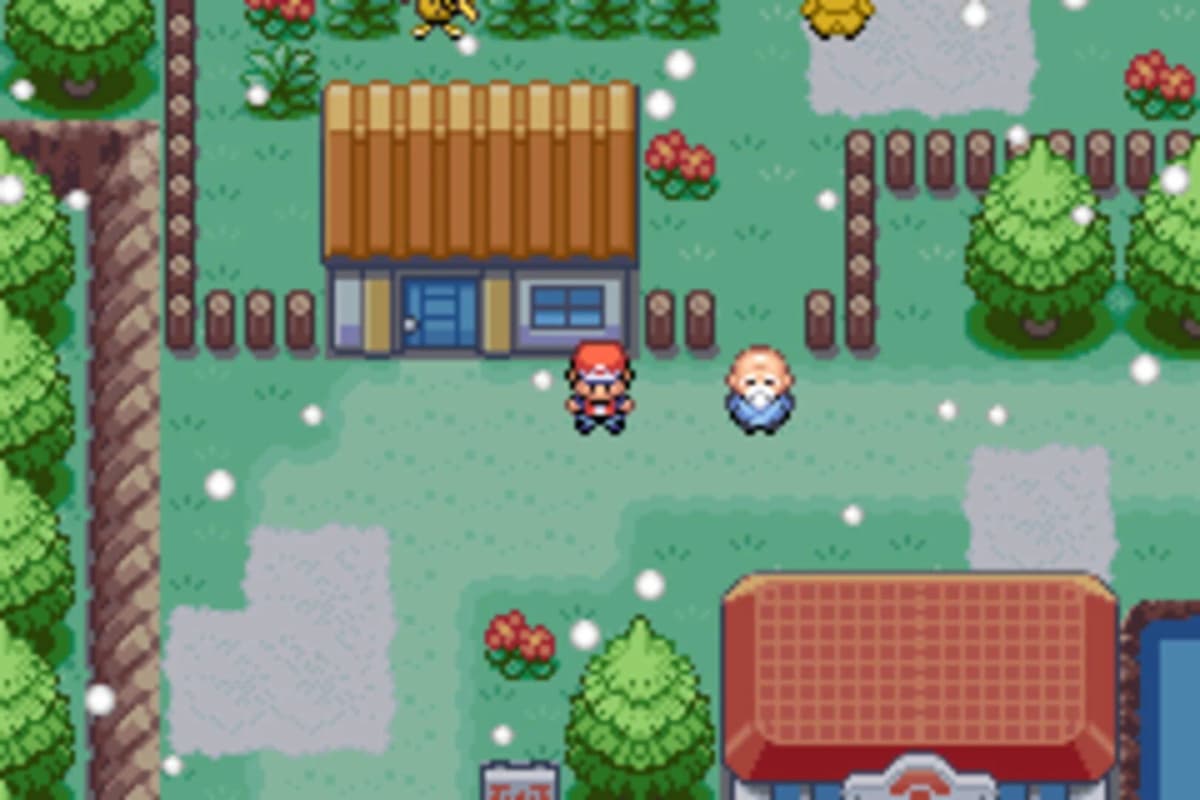
The first thing that hit me replaying this on Switch was how cozy the GBA art still looks when upscaled. It’s not the eye-melting pixel art flex you get from something like The Minish Cap or Golden Sun, but the sprites are clean, readable, and colorful in a way the original Game Boy never could manage. The towns pop, the battle sprites still have personality, and that late-advance-era color palette gives everything a warm, toy-like feel that modern 3D entries don’t really capture.
There are no gimmicks glued on top. No Z-Moves to juggle, no Dynamax cutscenes, no open world to get lost in. It’s just the classic loop: route → cave → town → Gym → rival fight, repeated with surprising confidence. After spending years in the anything-goes chaos of Scarlet and Violet, there was something refreshing about the straightforwardness here. I stopped thinking about systems and started thinking about my team.
I’m not particularly nostalgic for the GBA era – my emotional home is more DS/3DS – but after a few hours, FireRed and LeafGreen’s “plainness” started to feel like a strength. No feature sprawl. No bloat. Just enough UI and mechanical complexity to keep battles interesting, but not enough to get in the way.
Difficulty and Dungeons: When Pokémon Still Expected You to Try
The biggest shock coming back to these games was how much more they expect from you compared to recent entries. They’re not brutal by any stretch, but they also don’t treat you like you’re made of glass.
There’s no party-wide Exp Share smoothing over every level gap. You get the classic held-item Exp Share, and that’s it. If you want a full squad of six to stay on pace, you actually have to rotate them into fights. I found myself doing old habits I’d completely abandoned: throwing a low-level mon into battle, swapping it out, using the early routes to bring new catches up to speed. It’s busier, but it also made me more attached to the team I was building.
Gym Leaders and key battles lean into this. Brock and Misty will punish you if you stroll in with bad type coverage or an under-leveled squad. The Elite Four, in particular, is still a wall if you don’t grind at least a little or build around some decent strategies. When I first tackled them around the low 50s, I got flattened by Lorelei’s bulk and Lance’s Dragonite. I actually went back, adjusted moves, leveled a bit, stocked up on items, and tried again – something I almost never bother with in modern Pokémon because I rarely need to.
The part that really hammered home how different this era is, though, is the dungeon design. These games still have legit attrition-based dungeons: Rock Tunnel, Pokémon Tower, Victory Road, the Seafoam Islands… places where your PP, potion stash, and team composition matter.
In Sword and Shield or Scarlet and Violet, you heal constantly and landmarks are mostly breezy setpieces. In FireRed/LeafGreen, a long cave with no Nurse in sight means you’re counting Super Potions, debating whether to press deeper or turn back, and tweaking which moves you’re willing to burn PP on. Crawling through Rock Tunnel by flashlight, low on items and desperately trying not to trigger another Geodude encounter, reminded me that Pokémon used to flirt with being a light dungeon crawler, not just a collectible battler.
That does cut both ways. If you hate grinding or get impatient with random encounters, some stretches will absolutely test you. But I appreciated having to think again instead of steamrolling everything with one over-leveled starter.
The Kanto Lock and Gen 3’s Weird Limitations
For all the good the “back to basics” approach does, the way FireRed and LeafGreen handle non-Kanto Pokémon is easily the most frustrating part of the experience in 2026.
Under the hood, these are Generation 3 games. That means Johto and Hoenn Pokémon exist in the code, and the broader Gen 3 mechanics are there: natures, abilities, held items, etc. But for the entire main story, the Pokédex is hard-locked to Kanto species. The game is constantly reminding you there’s more under the surface, while refusing to actually let you touch it until the end.
The most visible symptom is evolution gating. If you’re raising a Golbat and build up its friendship, it will try to evolve to Crobat every level once it’s happy enough… and then fail. Over and over. The evolution screen pops, the animation starts, and the game just shuts it down because Crobat isn’t “available” yet. It feels artificial and honestly a bit mean.
Other cases are just hard noes. There’s no day–night cycle here, so Espeon and Umbreon are simply unobtainable natively. A handful of Johto Pokémon drip in through the Sevii Islands after the credits, but we’re talking about a small selection, not suddenly having a full three-region Pokédex to play with.
In the original GBA ecosystem, this all made more sense. These games were designed to connect with Ruby, Sapphire, and Emerald for trading and National Dex completion. On Switch, that context is gone – those Hoenn games aren’t here (at least as of this writing), so the huge “postgame quest” built around unlocking cross-region trading now leads to a reward you can’t really use.
I understand wanting to keep Kanto’s flavor intact for the main story, but the way the game rigidly enforces it feels like you’re bumping into invisible walls. You’re reminded constantly that the world is technically bigger; you’re just not allowed to see it.
Movepools, Region Design, and Other Ways the Age Shows
Even if you accept the Kanto focus, you’re still dealing with some very “2004” design decisions – and those are much harder to defend.
The movepools in particular can be rough. Game Freak hadn’t really embraced giving every Pokémon a reasonable same-type attacking move on level-up yet, so a lot of species feel half-finished:
- Pinsir learns zero Bug-type moves via level-up. A Bug-type ace that never actually gets to feel like a Bug-type attacker unless you burn TMs.
- Sandshrew doesn’t learn a proper Ground-type move until Sand Tomb at level 45, long after most players would reasonably still be using it as a mainstay. Earthquake, the good TM you actually want, only shows up after beating the 8th Gym.
If you’re coming from later generations where almost everything gets a decent STAB move on the way to level 30, this feels bizarre. I had to read move lists ahead of time just to avoid committing to a Pokémon that would be stuck spamming Normal-type attacks for 80% of the game.
Then there are the small but constant friction points. You can’t run indoors, so navigating big structures like department stores and Silph Co. becomes a slow trudge. The region itself still has that maze-like, artificially segmented Kanto layout: ledges, cut trees, and weird choke points that feel more like puzzle gating than a believable world.
Kanto has always been more “excellent level design” than “convincing geography,” but revisiting it in 2026 highlighted that for me. Compared to Johto, Hoenn, Sinnoh, or even Alola, it feels more like a cleverly arranged obstacle course than a place where people might actually live. It’s functional, and I still enjoyed routing through it, but I can’t pretend it holds up as my favorite region anymore.
Envie de passer au niveau supérieur ?
Accédez à des stratégies exclusives, des astuces cachées et des analyses pro que nous ne partageons pas publiquement.
Guide stratégique ultime Uncategorized + Astuces pro hebdomadaires
Switch Port Realities: Great Value, Strange Omissions
On Switch, FireRed and LeafGreen are basically faithful ports with a few nice bonuses and a few glaring absences.
The headline win is simple: accessibility and price. Original cartridges have gotten silly expensive on the second-hand market, and GBA hardware isn’t exactly something everyone has lying around. Here, each version is $20 USD, and my first playthrough of FireRed clocked in around 35–40 hours without even fully clearing the Sevii Islands or doing serious postgame grinding. That’s more time than I’ve squeezed out of some full-price Switch titles, and I wasn’t rushing.
There are also two built-in event distributions that flip on after you enter the Hall of Fame: the Birth Island Deoxys encounter (which can be shiny) and an event that lets you catch Ho-Oh and Lugia. On GBA, those events were locked behind physical distribution campaigns; getting them without cheating in 2026 would be almost impossible. Having them just… there, waiting, is a genuinely cool preservation win, and Nintendo weirdly didn’t make a huge deal out of it.
But for every nice touch, the ports also feel surprisingly barebones. The most painful omission is online play. Trading and battling are strictly local. That means there is no practical way to complete the Pokédex unless:
- You have a friend nearby with their own Switch and their own copy of the game, and you’re both willing to coordinate version exclusives and trade-evolution species, or
- You own two Switch consoles and buy the game twice to trade with yourself.
Given how central trading is to Pokémon’s identity – and how trivially standard online functionality feels on Switch in 2026 – its absence stands out. It’s not game-breaking for a casual campaign playthrough, but if you have any collector instincts at all, it stings.
Beyond that, the experience is almost aggressively faithful. Many of the quality-of-life things we’ve come to expect simply aren’t here: the bags are clunkier to sort, there are no fancy scaling or filter options, and the structural quirks of the GBA originals remain untouched. You’re getting FireRed and LeafGreen, not a “modernized” edition.
Who FireRed & LeafGreen on Switch Are Really For
After living with FireRed on Switch for a good chunk of time, I ended up with a pretty clear sense of who’s going to get the most out of it.
- Lapsed fans who bounced off the modern games: If you found Scarlet/Violet too messy or bloated, the stripped-back structure here will feel like coming home. Battles have bite, routes are clear, and the dungeon focus is back.
- Long-time players chasing a “definitive Kanto” playthrough: Between the cleaned-up visuals, Sevii Islands, and event legendaries, this is about as complete a classic Kanto as you can get, short of going to HeartGold/SoulSilver specifically for Kanto as an add-on.
- Newcomers who want to understand classic Pokémon design: If you’ve never really played the older generations and want to see what the pre-3D era was like, this is a great entry point – as long as you’re okay with some dated jank.
Where I’d be more cautious is with people who see Pokémon mainly as a chill, low-friction collectathon. The stricter experience curve, lack of online trading, and old-school dungeons can feel like work if what you want is a breezy nostalgia tour. And if your favorite part of the series is experimenting with giant movepools and regional diversity, Kanto’s narrow roster and Gen 3 limitations will feel tight.
Bottom Line: Classic Design, Uneven Package
After 35+ hours with FireRed on Switch, I ended up in a strangely conflicted place. As games, FireRed and LeafGreen still absolutely hold up. The tighter difficulty, real dungeons, resource management, and cozy GBA presentation combine into a version of Kanto that made me care about team-building and routing again. It reminded me why the series blew up in the first place.
As a 2026 release, though, the package feels half a step short of what it could have been. The rigid Kanto lock, missing online features, and unapologetically old QOL quirks keep this from being an easy, universal recommendation. You have to want what these games are offering: a classic, slightly prickly RPG rather than a smoothed-out modern comfort game.
For me, that trade was worth it. I’d rather take this slightly rough, focused Kanto over the flashier but shallower takes we’ve gotten since. I just wish the Switch port had met it halfway on a few obvious fronts.
TL;DR
- What it is: Faithful Switch ports of the 2004 GBA remakes of Pokémon Red/Blue, with Kanto remade in Gen 3 style and Sevii Islands postgame.
- What’s great: Tougher battles than modern entries, real dungeons that force resource management, charming GBA visuals, built-in Deoxys/Ho-Oh/Lugia events, and strong value at $20.
- What’s dated: Kanto-only main story with awkward evolution locks, small pre-postgame Pokédex, terrible movepools for some species, no running indoors, and maze-like region design.
- Biggest miss: No online trading or battling, making Pokédex completion a hassle unless you have a local trading partner or multiple consoles.
- Who should buy: Fans who want a focused, slightly tougher classic Pokémon experience or a definitive Kanto run; newcomers curious about old-school design and okay with some friction.
- Who should skip: Players who prioritize modern conveniences, broad team variety, or online features over tight, old-fashioned RPG structure.